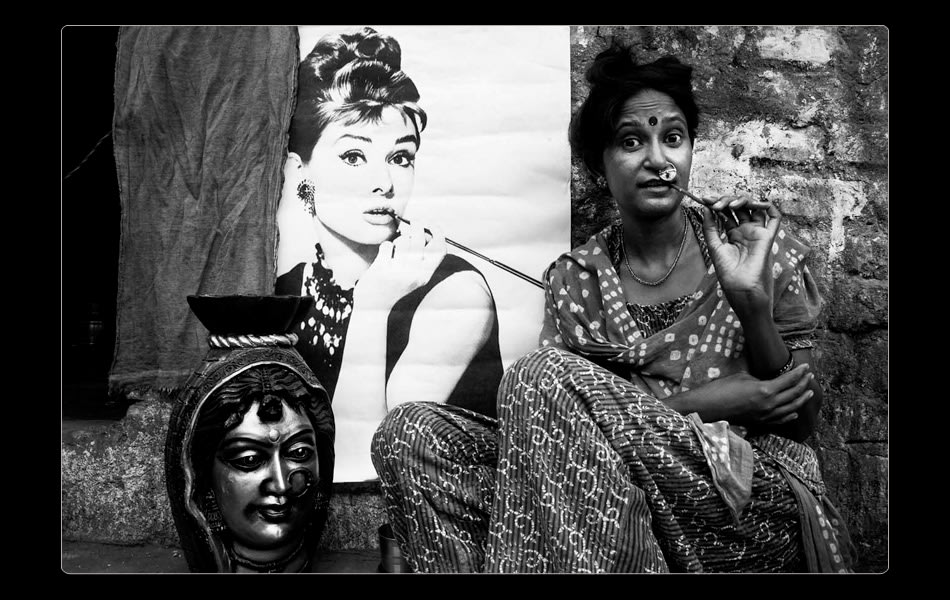
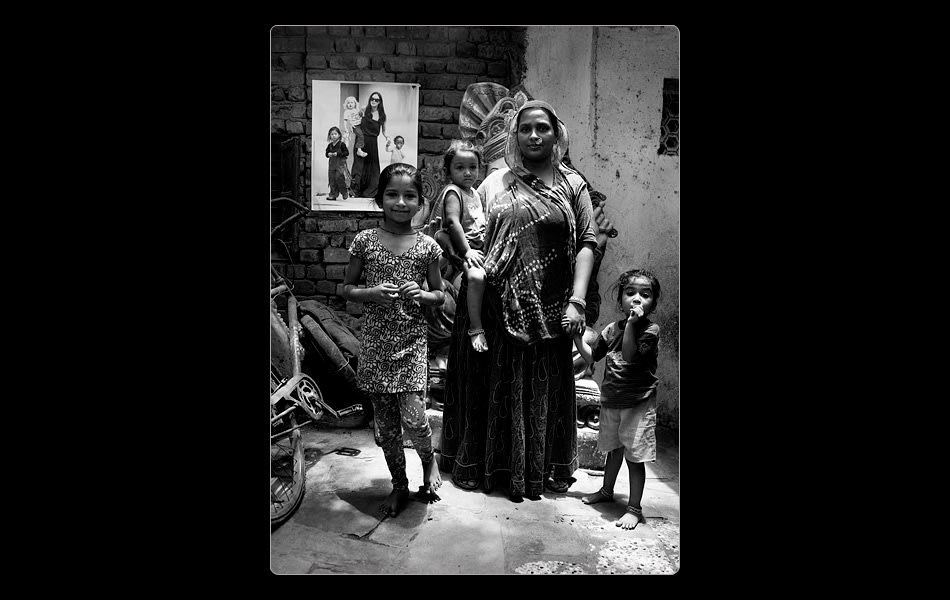
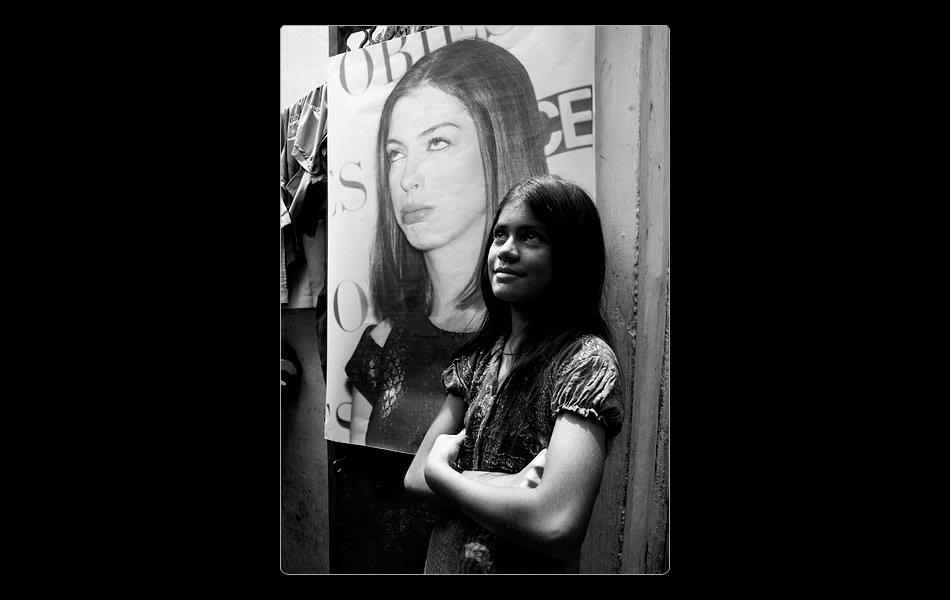
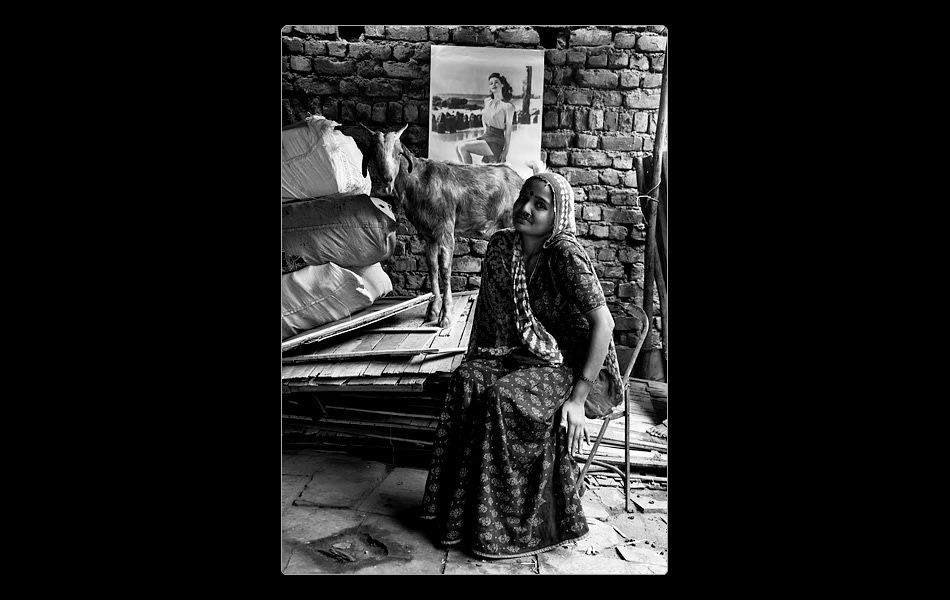
In these days of discord, disharmony, conflict and competition, finding affinity between two entities that are geographically far apart and no match to each other in socio-economic or cultural terms, is impossibility. But that is what this photo series did, and it went on to discover the impossible - A small slum area in the heart of the posh new city of Ahmedabad called HOLLYWOOD. The actual name of the area is Gulbhaitekra, but it has been popularly known as HOLLYWOOD for the last 4 decades for the reason that the women living here have a rustic beauty and glamour which is found to resemble that of Hollywood stars. Photographer KANNAGI KHANNA shares her images as she meets the enchanting women of Hollywood.

Showing posts with label Articles. Show all posts
Showing posts with label Articles. Show all posts
Monday, 23 April 2012

Thursday, 13 October 2011
A delightful short story I read way back in class 10!
A Day's Wait
By,
Ernest Hemingway
He came into the room to shut the windows while we were still in bed and I saw he looked ill. He was shivering, his face was white, and he walked slowly as though it ached to move.
"What's the matter, Schatz?"
"I've got a headache."
"You better go back to bed."
"No. I'm all right."
"You go to bed. I'll see you when I'm dressed."
But when I came downstairs he was dressed, sitting by the fire, looking a very sick and miserable boy of nine years. When I put my hand on his forehead I knew he had a fever.
"You go up to bed," I said, "you're sick."
"I'm all right," he said.
When the doctor came he took the boy's temperature.
"What is it?" I asked him.
"One hundred and two."
Downstairs, the doctor left three different medicines in different colored capsules with instructions for giving them. One was to bring down the fever, another a purgative, the third to overcome an acid condition. The germs of influenza can only exist in an acid condition, he explained. He seemed to know all about influenza and said there was nothing to worry about if the fever did not go above one hundred and four degrees. This was a light epidemic of flu and there was no danger if you avoided pneumonia.
Back in the room I wrote the boy's temperature down and made a note of the time to give the various capsules.
"Do you want me to read to you?"
"All right. If you want to," said the boy. His face was very white and there were dark areas under his eyes. He lay still in the bed and seemed very detached from what was going on.
I read aloud from Howard Pyle's Book of Pirates; but I could see he was not following what I was reading.
"How do you feel, Schatz?" I asked him.
"Just the same, so far," he said.
I sat at the foot of the bed and read to myself while I waited for it to be time to give another capsule. It would have been natural for him to go to sleep, but when I looked up he was looking at the foot of the bed, looking very strangely.
"Why don't you try to go to sleep? I'll wake you up for the medicine."
"I'd rather stay awake."
After a while he said to me, "You don't have to stay in here with me, Papa, if it bothers you."
"It doesn't bother me."
"No, I mean you don't have to stay if it's going to bother you."
I thought perhaps he was a little lightheaded and after giving him the prescribed capsules at eleven o'clock I went out for a while.
It was a bright, cold day, the ground covered with a sleet that had frozen so that it seemed as if all the bare trees, the bushes, the cut brush and all the grass and the bare ground had been varnished with ice. I took the young Irish setter for a little walk up the road and along a frozen creek, but it was difficult to stand or walk on the glassy surface and the red dog slipped and slithered and I fell twice, hard, once dropping my gun and having it slide away over the ice.
We flushed a covey of quail under a high clay bank with overhanging brush and I killed two as they went out of sight over the top of the bank. Some of the covey lit in trees, but most of them scattered into brush piles and it was necessary to jump on the ice-coated mounds of brush several times before they would flush. Coming out while you were poised unsteadily on the icy, springy brush they made difficult shooting and I killed two, missed five, and started back pleased to have found a covey close to the house and happy there were so many left to find on another day.
At the house they said the boy had refused to let any one come into the room.
"You can't come in," he said. "You mustn't get what I have."
I went up to him and found him in exactly the position I had left him, white-faced, but with the tops of his cheeks flushed by the fever, staring still, as he had stared, at the foot of the bed.
I took his temperature.
"What is it?"
"Something like a hundred," I said. It was one hundred and two and four tenths.
"It was a hundred and two," he said.
"Who said so?"
"The doctor."
"Your temperature is all right," I said. "It's nothing to worry about."
"I don't worry," he said, "but I can't keep from thinking."
"Don't think," I said. "Just take it easy."
"I'm taking it easy," he said and looked straightahead. He was evidently holding tight onto himself about something.
"Take this with water."
"Do you think it will do any good?"
"Of course it will."
I sat down and opened the Pirate book and commenced to read, but I could see he was not following, so I stopped.
"About what time do you think I'm going to die?" he asked.
"What?"
"About how long will it be before I die?"
"You aren't going to die. What's the matter with you?"
"Oh, yes, I am. I heard him say a hundred and two."
"People don't die with a fever of one hundred and two. That's a silly way to talk."
"I know they do. At school in France the boys told me you can't live with forty-four degrees. I've got a hundred and two."
He had been waiting to die all day, ever since nine o'clock in the morning.
"You poor Schatz," I said. "Poor old Schatz. It's like miles and kilometres. You aren't going to die. That's a different thermometer. On that thermometer thirty-seven is normal. On this kind it's ninety-eight."
"Are you sure?"
"Absolutely," I said. "It's like miles and kilometers. You know, like how many kilometers we make when we do seventy miles in the car?"
"Oh," he said.
But his gaze at the foot of the bed relaxed slowly. The hold over himself relaxed too, finally, and the next day it was very slack and he cried very easily at little things that were of no importance.
Wednesday, 28 September 2011
The good Bad and the bad Good

Painting: The good Bad and the bad Good
Date: 24th August 2011
Medium: Acrylic colors on A3 canvas
Date: 24th August 2011
Medium: Acrylic colors on A3 canvas
It is a bright summer afternoon. Yellow is dancing with the orange – the two flow across while playing with the rough texture of the canvas. Sunrays expose the excitement of the green foliage, which is now spreading its fragrance on the canvas. I close my eyes trying to fathom the contents of the fragrance – flowers, foliage, sea, breeze… Life is so good – no constraints, no chains, no bad. Ironic it is! Good thoughts give rise to the excitement of the absence of the bad, which in turn reinforces the belief in the presence of the bad… The bright day will inevitably decay into the dark night. Soon the light blue bright summer sky melted into the starry dark blue and the all absorbing black. The blue and black now violently struggle on the limited space of the canvas. But why am I afraid of the dark? Is Bad so bad? The turmoil on the canvas decrease…
I look around to understand what good is Good for. Let’s do an experiment! I search for the most lively and beautiful thing around. There it is – a bright red hibiscus! I plead the canvas to answer my dilemma. Delicately the flower is absorbed by the canvas. As I wait patiently to see what happens to the lively flower when it is swallowed by the Bad and the Good, my confusion starts heightening. Five minutes.Ten.Twleve. Sixteen. At twenty, the canvas shocks me. The stem of the flower starts growing form the Bad, the black. It is burning to live. Its celestial light glows incessantly. I could hear it breathing, living, and surviving in the dark. It loves the challenge, lights the dark and leaves the world awe-struck. As it grows into the light of the Good, the stem lazily bends down. The flower growing on it is sluggish, tired and bent in the nothing-to-do world. Life is too easy to be challenging in the Good to be good. Is the Good really good and Bad really bad? I take a deep breath, almost thanking the canvas to sensitize me to the possibility of the absence of absolutes – the good Good and the bad Bad. If there is no good Good… the Bad is good and Good is bad, what is Good at all? I contain the question in myself, what’s the fun in easy solvable questions if they can be solved!
As I walk back Dillard’s words resonate in my mind. “She burnt for two hours without changing, without bending or leaning – only glowing within, like a building fire glimpsed through silhouetted walls, like a hollow saint, like a flame faced virgin gone to God, while I read in her light, kindled, while Rimbaud in Paris burnt out his brains in a thousand poems, while night pooled wetly at my feet.”[1]
[1] Annie Dillard: Death of a Moth. Harper Magazine (1976)
Saturday, 17 September 2011
THE CONFUSED METAPHOR IN THE MAKING
Heming Ram Chelsea was an inquisitive man, who spent more time deliberating of what people would be like than actually understanding them. It was a game for him to match the person with their corresponding stereotype. He never believed in the progressive postmodern jive of multiple narratives, everything he said can be put into one box.
As he sipped his coffee at the poloros cafe he noticed a young man enter, neatly clad wearing a confident smile and swinging his arms vigourously. He must definitely be rich,unmarried and working as an under the table operator for a business thought Heming. To his dismay this young man walked towards him with his coffee and an expression that forced him to say " would you like to join?" In a gruffy voice he replied " That would be charming" charming... thought Heming that was not the reply he was hoping for, what with his foreboding beard,unkempt hair and his clutching onto a copy of 'A vindication of Natural Society' by Edmund Burke ( This was his toolbox of isolation). " My name is Rohington Jerum and you are ?" already uncomfortable he replied in a hesitant tone " Heming Ram." " Wonderful, I work right around the corner, I deal with antiques-I do not deal per say but I make the deals happen, what is it that you do apart from sipping coffee with burke?" not so impressed by his sly wit Hem replied " Well, I do a bit of a lot of things, I served in the army for a few years got bored of killing and decided to do something more appealing so I began to write and comment on the happenings of the world." " Tell me more" pleaded Rhington, annoyed by the request Hem began to narrate his undefined occupation " Well, I study a particular event from any time period and try and fit it in the current political context. Like a few weeks ago my piece on the Churchill, to be more specific in 1899 churchill was a journalist at the Boer War he was captured but he managed to escape but only this time Winnie was covering the war in Iraq and was captured by american G.Is... " Rohington looked amazed at this revelation " That is bloody brilliant! but how do you come up with these experiences as in how do you recreate them in your mind?"
Hem now knew he was going to be having more than just this cup of dark Kopi Luwak." Ro if I may, this recreation is possible because I believe in what I call specific reality, there is one reality which is the truth but multiple perceptions which are false. I undo all that crap of different understandings and just dig up the truth from my research." Shocked Ro now seemed offended by this concept " So how do you know if your truth is true? " In a squemish tone Hem retorted " Look kido, it is true because everyone else believes it is what happened. Its like this JFK is dead its true he is not an Elvis to be found in every corner. I only talk about JFK as dead I do not venture into how he died" interesting thought Ro. As another scheme under his belt Hem decided to unveil his favourite weopen a thought experiment- " Well Ro what if I maufactured reality, imagine you are walking on a bed of smooth beach sand towards a shapeless figure and it will take the shape that you want it to take. The trick is to find out the right spot to stop because if you get close enough it will become real" Ro raised his eyebrows and clenched his jaws as he arrived at an answer, he hastily replied " I would imagine the shape of a young maiden and I would go close enough till she was real"
Hem laughed as he was now sure that Ro was unmarried. " The only thing I gained from your comment is that you need to find a wife soon apart from that you did not get the point of the experiment. The shapeless form is the truth and its shape becomes finer as our perception chisels it and finally we dwell so deep into our perceptions that they become real. Its like this cup of coffee we both know its present in front of me which is true.I then take a sip and I realise that I do not like it much so I then tell everyone that the coffee here at Poloros is ghastly.In all of this the coffee being present in front of me is true the rest my friends is bollocks. I am just trying to strip away the truth from the fancy dressing of unreal perception in its basic form"
Unnerved by this interaction Rohington had his last sip of coffee and said " You know Hem in your world I do not know if this event is true as I am percieving it. your heady conversation has made me question whether I am here or in a parallel state, enjoy your coffee" Hem wore a sign of contentment as he could finally go back to sipping his charming dark coffee with Burke by his side.
Friday, 16 September 2011
Neipayasam / Sweet Milk
Sweet Milk
Translated (by Late Kamala Surayya) from the Malayalam story ‘Neipayasam’ by Sindhu V. Nair with TLM
A man, returning home at night from a simple cremation, having thanked everyone. We could simply call him Achhan. Because only three children in the city know his value. They call him Achha.
Sitting in the bus among strangers, he went over every second of that day.
Woke up in the morning to her voice. "Unniye, don’t go on sleeping covered up like that. It’s Monday." She was calling the eldest son. She then moved to the kitchen, her white sari crumpled. Brought me a big glass of coffee. Then? What happened then? Did she say anything that should not be forgotten? However much he tried, he could not remember. "Don’t go on sleeping covered up like that. It’s Monday." Only that line lingered. He chanted it to himself, as if it was a prayer. If he forgot it, the loss would be unbearable.
The children had been with him when he left for work in the morning. She brought them their tiffin in small aluminium boxes. A smear of turmeric on her right hand.
At work, he did not think of her at all. They had married, against the wishes of their parents, after a courtship of a year or two. But they never did regret it. Lack of money, the children’s spells of illness — they were often dejected. She became careless of her appearance. To an extent, he lost the ability to laugh.
Still, they loved each other. Their three children also loved them. They were boys. Unni, 10, Balan, 7, and Rajan, 5. Three boys whose faces were always smeared with dirt, who had neither outstanding beauty nor brilliance. But the mother and the father said to each other —
"Unni is always making things. He has a taste for engineering."
"We should make Balan a doctor. See his forehead: such a wide forehead denotes intelligence."
"Rajan is not afraid of the dark. He is smart. He should join the army."
They lived in a narrow street in the city, in a middle-class neighbourhood. A three-room flat on the first floor, with a veranda just wide enough for two people to stand in. Mother grows a panineer plant in a pot. It has not flowered yet.
In the kitchen, brass spatulas and ladles hang from the hooks on the wall. A wooden plank lies near the stove. Mother usually sits there, making chapatis when Father returns from work.
He got off when the bus stopped. He felt a twinge of pain in the knee. The beginning of arthritis? Who will look after the children if I am bedridden? Suddenly, his tears welled up. He rubbed his face with a dirty kerchief and quickened his step.
Have the children gone to sleep? Had they eaten anything, or had they just cried themselves to sleep? But they are too young to understand. Unni just stood there watching me when I put her in the taxi. Only the youngest one cried. But that was because he wanted to get into the taxi too. Certainly, they did not know the meaning of death.
Did I know? No. Did I ever imagine that she would suddenly fall down one evening and die, without saying farewell to anyone?
He had looked in through the kitchen window when he came back from work. She was not there.
He could hear the sound of children playing in the front yard. "First-class shot." It was Unni calling out.
He opened the front door with his key. It was then that he saw her. She was lying on the floor. Her lips were parted. She must have slipped, he thought. But at the hospital the doctor told him: "She died an hour and a half ago. It was heart failure."
He was swept by a welter of emotions. He was angry with her for no reason. How could she go, without any warning, burdening me with all the responsibilities!
Now who would bathe the children? Who would cook for them? Who would look after them when they fell ill?
"My wife died," he whispered to himself, "my wife died suddenly today of a heart attack. I need two days’ leave."
A great leave application. Leave, not because the wife is ill. Leave, because the wife is dead. The boss might call him to his room. He might express his sorrow. His sorrow! Who wants it? He didn’t know her. He didn’t know her hair that curled at the ends, her tired smile, her slow step. All these are his losses.
When he opened the door his youngest son came running up. "Mother isn’t back yet," he said.
How quickly he has forgotten! Did he really think that the body that was taken away in the taxi would come back alone?
He took him to the kitchen.
"Unni," he called.
"What is it, Achha?"
Unni came into the kitchen.
"Balan is sleeping."
"All right. Have you all eaten anything?"
"No."
He removed the plates covering the vessels kept on the sill. Chapatis, rice, potato curry, chips, curds — the food she had made. In a glass bowl, the neipayasam that she sometimes made for the children.
No, they should not eat this food. It is touched by death.
"These have gone cold. I’ll make some uppumavu," he said.
"Achha..." it was Unni.
"Um?"
"When will Mother come back? Isn’t she better?"
Let the truth wait for another day, he thought. There was no point in giving grief to the child tonight.
"Mother will come," he said.
He placed the washed bowls on the floor. Two bowls.
"Let Balan sleep," he said.
"Achha, neipayasam," Rajan exclaimed happily. He dipped a finger in it.
He sat down on the wooden plank where his wife usually sat.
"Unni, will you serve? Achhan does not feel too good. Headache."
Let them eat. They would never again be able to eat their mother’s cooking.
They started eating the payasam. He sat motionless, watching them.
"Don’t you want rice, Unni?"
"No, we want only payasam. It’s very tasty."
"Yes, Mother has made splendid neipayasam," Rajan said happily.
He got up and walked quickly towards the bathroom.
Thursday, 8 September 2011
My Wage
Here's a poem that I loved reading. I've reproduced it here for you.
MY WAGE
By,
Jessie B. Rittenhouse
I bargained with Life for a penny,
And Life would pay no more,
However I begged at evening,
When I counted my evening store;
For Life is just a employer,
He gives you what you ask,
But once you have set the wages,
Why, you must bear the task.
I worked for a menial's hire,
Only to learn, dismayed,
That any wage I had asked of Life,
Life would have paid.
Tuesday, 30 August 2011
Theyyam- The Divine Concept

Theyyam is a popular Hindu ritual of worship in north Kerala. This cult is an ancestral one. Hindu population is divided by castes. This worship has got the particularity of involving all the caste and classes of the Hindu religion living in the region. But Theyyam is performed by male members of particular castes only. Men from Malayan, Pulayan, Vannan, Anjoottan, Munnutton, Velan, Chungathan, Koppalan and Mayilon are part of the castes who perform Theyyam.
The performers of Theyyam are all members of the indigenous tribal community, and they have an important position in Theyyam. This is unique, since only in Kerala, do both the upper-caste Brahmins and lower-caste tribals share an important position in a major form of worship. The term Theyyam is a corrupt form of Devam or God. People of these districts consider the performers of the Theyyam itself as a deities and they look forward blessings from this Theyyam. To get the appearance of super-human, original and colourful costume and make-up are used in theyyam dances. An essential component of the costume of theyyam dancer are the leaves of coconut tree which are cut and made into different shapes and sizes. All the dancers wear a very special massive headgear whom the structure is usually prepared from arecanut tree and bamboo as it is for the « uduthukettu », the waist-dress. It takes hours to make up and prepare the dancers. People from the village attend to the metamorphosis. The face is decorated with a red make up. To make the costumes more attractive, red colored flowers are also sticked to the fancy dresses. The performance stands in front of the village and all the people can attend to it. The devotees would be standing or some of them would be sitting on a sacred tree in front of the shrine. What does Theyyam is all about ? It tells the story of people who lost their lives in battlefield, pangs of women who committed suicide or persons killed by the local chieftains. Such people are honoured through theyyams performed in front of shrines. The dancer along with the drummers recites the particular ritual song, which describes the myths and legends, of the deity of the shrine or the folk deity to be propitiated. The dancer comes in front of the shrine and gradually “metamorphoses” into the particular deity of the shrine. There are about 450 known forms of « theyyams » and each has got its own myth and style of costumes, make-up, choreography and songs. After the dance, people consult also the dancers because they communicate forecasts and see the future. There is a charge for the consultation.
(Text courtesy:http://www.flickr.com/photos/mytripsmypics/2297238853/in/set-72157604002360053/)
Read more..
Saturday, 27 August 2011
A story- 'Put aside our old baggage'

Eagles are the most long-lived bird in the world. By the time they reach 40 years old, their claws will start to age, losing their effectiveness and making it hard for them to catch prey.The life-span of an eagle is up to 70 years old.
But in order to live this long, it must make the toughest decision at 40. At 40, its beak is too long and curvy that it reaches its chest. Its wings, full of long, thickened feathers, are too heavy for easy flying. The eagle is left with 2 choices:-
(1) do nothing and await its death; or(2) go through a painful period of transformation and renewal.
For 150 days, it first trains itself to fly beyond the high mountains, build and live in its nest and cease all flying activities. It then begins to knock its beak against granite rocks till the beak is completely removed. When a new beak is grown, the eagle will use it to remove all its old claws and await quietly for new ones to be fully grown. When the new claws are fully grown, the eagle will use them to remove all its feathers, one by one.
Five months later, when its new feathers are fully grown, it will soar in the sky again with renewed strength and is able to live for the next 30 years.
In life, as an individual, in an organization, sometimes, we have to learn to make difficult decisions so as to make room for changes. Changes bring about renewal. And the only way for us to soar again is to let go old ways, old habits, old lives.
For as long as we are prepared to put aside our old baggage - past glory or shame, past success or failure - be willing to become zero, with an empty cup mentality, we will be able to discover our potential and head towards a renewed perspective in any aspect of our lives
- anonymous
Wednesday, 24 August 2011
Down The Memory Lane - The Times of DD
I am back with my blog, this time a humble and nostalgic effort to take back to your childhood days..Cheers!!
The weekend was bad, rather not so good; my back ache had buckled me to the bed, not allowing me to stay in one position for more than 4-5 minutes. I was surfing through the television channels lying on bed, and soon I noticed that I was doing nothing but going from 0 to 54 (that is the only number of channels I have on my television) and then again 0 to 54, and then again and again. I was tired watching that Indo-Pak terror debate, reality shows were irritating me, and I couldn’t handle any more breaking news with my broken back, neither was I interested in any kind ofsaas-bahu or the rona-dhona type of soaps, south Indian films dubbed in hindi were a big NO, I was in no mood for business news either, I had also had enough of Ghajini and Rab Ne trailors, songs, and reviews. I remember, only thing that possibly kept me glued to any particular channel was the advertisements – Limca (I love this ad for its jingle, the zing, and the babe, of course),Raymond, Bingo, few insurance ads, ads with kids in them, and so on, however, that was short-lived, hardly for few seconds. I would have watched Balika Vadhu!! (;-) ) on Colors, but I had already finished watching the episodes all through the week. I thought better it was to switch off the television and continue reading a book, long due -One Hundred Years of Solitude. My reading was short-lived as well; I was twisting and turning myself on the bed all the while. I thought of switching on the television again, but then there is nothing to watch. Really? Wasn’t there a single program or anything on any channel that would interest me? Has this all time entertainer idiot-box turned into a dumb piece of scrap? I mean yes, there was once a time, when I used to run to watch particular program leaving back playing cricket or not worrying much about how crowded the train was. Ahhh! Yes that was the time of Doordarshan – a single channel then (80’s & 90’s), which entertained, educated, informed, and served special feast of programs on the weekends, especially Sunday. It was good. It was only one channel and there were no remotes either at that time, thus the urge to surf to some other channel was obviously ruled out. However, let’s not take away the credit of what Doordarshan was at that time, just because of this reason. I still cherish those memories of yesteryears – watching DD (Doordarshan) programs on our black & white television housed in wooden box with horizontal shutters.
Quite immediately the DD logo flashed in front of my eyes, and I could vividly remember how the roads used to be empty on Sunday mornings, when Ramayan or Mahabharat were aired (in different years) – it used to be a curfew like situation. I still remember how my grandmother used to join her palms and bow down to Nitish Bharadwaj (played Shri Krishnain Mahabharat). Both these epic series were made so interesting and were so well narrated that you could hardly skip them. (Please let us not even think about comparing it to today’sRamayan and Mahabharatprograms, like some news channels did). What I had seen in my childhood was certainly class apart.


I used to love watching Duck Tales, cartoon show about Donald Duck (Uncle Scrooge), his quest for acquiring more gold, swimming in that pool of gold, and his 3 mischievous nephews, it was the best. Even my dear friend, Naman would concur on this (please help me with the names of those 3 little ducks- uui dui, lui I think). Pssst...Naman can still, till date, mimic Uncle Scrooge :-)


Do you remember Gayab Aya? It was on an animated character and had a good title song as well. Then there was “jungle jungle baat chali hai, pata chala hai, chaddi pehen ke phool khila hai phool khila hai” – yes Mowgli featured, Jungle Book, again a very interesting animation series, I loved its title song, and Sherkhan, and Bagira, and the Baalo.


The most hilarious comedy series I have ever seen is Didi’s Comedy Show – Saturday evenings 4.00 PM, if I am not wrong. I used to roll on the floor watching this – the character Didi (a German actor) and his encounters in daily life, if you see the kind of faces he can make and expressions he can deliver, Jim Carrey will soon fade off your memory.

Children’s series also had other good programs like the Stone Boy, Vikram Vetaal, Dada Dadi Ki Kahaniya (Ashok Kumar used to tell stories to kids, forgot the female dadi in this),Spiderman, Appu Aur Pappu (appu aur pappu ki dekho yaari, sabse pyaari sabse nyaari, appu aur pappu, appu aur pappuuuuuuu), Ek Doo Teen Char (ek doo teen char, ek doo teen char, charon milke saath chalet oh karde chamatkaar), Potli Baba Ki, Danasurr, and so many others.
And yes, there was this “taaanaaa naaa taaanaaa naa naa naa, taaanaaa naaa taaanaaa naa naa naa” – Malgudi Days, stories about Swami (Master Manjunath) and his friends.


Not only for children, but there was also good amount of entertainment for grown ups and family as well. On lighter side, there were Wagle Ki Duniya(Anjan Shrivastav & Bharti Achrekar),Yeh Jo Hai Jindagi (30 years ka experience hai line came from this series – Satish Shah, Swaroop Sampat, Rakesh Bedi, Shafi Inaamdar etc), Aaa Bail Mujhe Maar (Amol Palekar, Harish Patel),Manoranjan etc.


Mind you, there was some serious hair raising, tear trickling stuff enough to give you Goosebumps – Buniyaad, Humlog, Tamas, Palash Ke Phool (jab jab mere ghar aanaaaa, phool palash ke le aanaaa), Sukanya, Kali Ganj Ki Baho (not sure if this is name of the serial but had Nutan in it and it was my mom’s favorite.


Kshitij Yeh Nahi was another excellent 13 episode series that dealt with widow remarriage. I liked Supriya Pilgaonkar in this (and that’s the last time I liked her). Other good serials (my mother’s testimony) could include – Noopor(Hema Malini opposite Shekhar Kapoor, I think so),Trishna (Hindi remake of Pride and Prejudice), Gul Gulshan Gulfaam (starring Parikshit Sahani, stories about Kashmir and the scenic beauty of house-boats), Khaandaan, and I am sure there are many other.
There was another good emotional, family drama kind of serial – Imtihaan, starring Renuka Shahane, Aloknath, Raju Kher, and my among one of my crush, Firdaus Dadi – she was damn cute.
Udaan (pardon the image used, couldn’t find one in police uniform) and Rajani(ladki hai ek naam rajani hai, rajani, rajani – Priya Tendulkar with Karan Razdan as her screen husband) were two good serials that epitomized women power unlike today’s Tulsi and Parvati. Aarohanfeaturing Pallavi Joshi struggling with Air Force training and then rising to the top was another good series to see a woman in action.


Talking about Pallavi Joshi’s air force, Shahrukh’s Fauji comes gushing to my memory. Young SRK playing Abhimanyu Rai and taking army training – frankly at that time I never knew this Fauji would walk all the way to becoming the Donof today's Indian film industry. Shahrukh had also featured in another DD serial – Doosra Kewal and a few more guest appearances here and there.Paramveer Chakra was another inspiring serial based on defence and army.

Shahrukh also reminds me of another very good serial, Circus based on the lives of people working in a circus, their emotions, problems, bonding etc. The serial had Renuka Shahane (played Madhuri’s sister in Hum Aapke Hain Koun), Pavan Malhotra (played Tiger Memon in Black Friday, also Shahid’s uncle in Jab We Met), Makarand Deshpande (sang Yuhi Chala Chal Rahi with Shahrukh inSwades), Ashutosh Gowarikar (do I say anything about him? :-] ).
Another such serial which portrayed bonding and emotions of common people was Saeed Mirja’s Nukkad, which dealt with lives of small time workmen like sweeper, cycle mechanic, waiter, grocer, barber, beggar etc. It starred Rama Viz (teacher ji), Dilip Dhawan (Guru), Pavan Malhotra (Hari), and others. The characters of Ghanchu Bhikari and Khopdi had become quite famous at that time.
I remember serials based on college life and campus. Neev was the best one about student life in college and hostel; it had Ali Asghar (today’s Comedy Circusfame). Chunauti was damn good with Channa Ruparel (again someone I had fallen flat for), and the serial had Suchitra Krishnamoorthy (debut) as well. In Marathi, there was a serial called Sanskaar, again about school students with Mohan Joshi as their principal trying to teach discipline by a liberal approach.


Horror and suspense thriller also found enough accommodation in the entertainment space.Killey Ka Rahasya was the most horrifying one, I still remember the music and hand that approached on the screen, it was aired at 10.30PM, I had often skipped going for a leak before going to bed, it was so scary. Byomkesh Bakshi is the most intelligent detective serial I have ever seen. The plots, the solutions were splendid, so was Rajit Kapoor’s performance along with K. K. Raina (Ajit Banerjee) as his assistant. Tehkikaath – Vijay Anand (supposedly the king of suspense drama –Jewel Thief, Teesri Manzil) playing a detective with Saurabh Shukla (Kallu Mama) as his assistant. However, the most popular detective-assistant pair is undoubtedly Pankaj Kapoor (Shahid's dad, Abbaji in Maqbool)and Sushmita Mukherjee (dadi in new Golmaal) in DD's detective serial,Karamchand, with Sushmita Mukherjee playing his assistant, Kitty. Ek Shunya Shunya, andHello Inspector were other crime related serials that enthused me.


I learnt cricket with Mohinder Amarnath on Sundays. He taught all budding cricketers the basics of bowling, batting, and fielding in his program, Cricket with Mohinder Amarnath. I watchedThat’s Cricket with deep interest (I used to like cricket game then, till the time it was not so overly commercialised), and Bodyline on Sunday nights had made me crazy, the fight between England and Australia. Narottam Puri gave latest sports updates in his 4.00PM Saturday program – World of Sports.

Doordarshan had good educational and informative programmes as well. I particularly likedTurning Point, hosted by Girish Karnad and in the later stages by Mahesh Bhatt. The program gave a lot of information on evolution, science, universe, explained various phenomena, Dr. Yashpal used to show some simple do-it-yourself science experiments with excellent explanations and reasoning. Another program full of good information was Surbhi hosted by Renuka Shahane and Siddharth Kak. I never missed these two programs. Though I had not keenly followed Bharat Ek Khoj, I did like some of its episodes and the information it gave (not available in school history book).


News coverage also was good, did not understand much about professionalism at that time as I was of a tender age then, and there was no funda of breaking news or zooming camera angles or unnecessary background scores. The news readers looked very mature and professional unlike today’s casual ones. I liked the intro music (Tabla rhythm) of World this Week conducted by Prannoy Roy, and ofcourse the news covered in it. I used to see the same face everyday for years, which read news to me and to entire of India


“Mile surr mera tumhara”,“Tree of Unity”,“Ek Chidiya Anek Chidiya”were some snippets that I had never missed on DD then, I miss them terribly today though. Pardon me, but it was me who has quit watching television and with the quality of programs that are aired these days I would completely give up watching television, I anyways have lost control over the remote.Siddhartha Basu, the acclaimed father of Indian quiz shows, hosted a quiz program – Quiz Time. It was fun to see that and even more fun to answer the questions. There was no SMS regime that time.I though saw the whole series in a repeat telecast, because i wasn't born when it began!!!

There were many other programs that are still afresh in my memories. Programs related to movies like Show Theme, Chitrageet, Chayageet, andRangoli – this was aired at 7.00 AM on Sundays, and I used to get up prefect in time and watch this show of movie songs sitting on the floor brushing my teeth, Mother used to keep shouting, how I can get up so early on Sundays and why not on other days when I had to go to school..heee heee.
I remember serials like Kakkaji Kaheen, Mungeri Laal Ke Hasin Sapne,Ulta Pulta.My mother tells me i was so fascinated by Mungeri Lal, that they had given me the same nickname!!!A Mouthful of Sky, Swabhimaan(Channa Ruparel again), were among my favourite soaps that time – just for the sake of Milind Soman, Simone Singh, Channa Ruparel, Sandhya Mrudul.Swabhimaan could any day bring down the TRPs of today’s family sabotage and politics dramas. Performances by Manoj Bajpai, Ashutosh Rana, Rohit Roy, Mita Vashisht were amazing, I also liked Kitu Gidwani’s character name in that – Svetlana.
Doordarshan also had Junoon, Shanti (Mandira Bedi’s debut), Ajnabee(starring Danny Dengzongpa) to compete with today’s Kyun Ki…, Kahani…, etc, those serials were almost calibrated as non ending ones.
With the bunch of memories that stay with me of Doordarshan, the sweetest one is that the channel kept the family together, the family watched television together, had food together, laughed in one roar, sorrowed and consoled each other, and enjoyed together as well.
Just as I had finished the glimpse of those olden momentous days, a friend of mine walked with beer tins, popped out the clip and said, “Cheers to our friendship, long life, and happiness, and happiness, and….and…”
"And Doordarshan", I said, and we laughed happily ever after…hahahahaha.
"And Doordarshan", I said, and we laughed happily ever after…hahahahaha.
P.S- This is a narrative through time. Though I wasn't born when a few these were aired for the first time, but I made sure I saw these during their repeat telecast.
Subscribe to:
Posts (Atom)